Huang Po, Sixth Zen Patriarch
Excerpt | The Zen Teaching of Huang Po (On The Transmission Of Mind)
Tuesday, April 11, 2006
"This pure Mind,
the source of everything, shines forever and on all with the brilliance of its own perfection. But the people of the world do not awaken to it to it, regarding only that which sees, hears, feels and knows as mind. Blinded by their own sight, hearing, feeling and knowing, they do not perceive the spiritual brilliance of the source-substance. If they would only eliminate all conceptual thought in a flash, that source-substance would manifest itself like the sun ascending through the void and illuminating the whole universe without hindrance or bounds."


Beautifully Complex Universal Rumi
Your grief for what you've lost lifts a mirror
up to where you're bravely working.
Expecting the worst, you look and instead,
here's the joyfull face you've been waiting to see.
Your hand opens and closes and opens and closes.
If it were always a fist or always stretched open,
you would be paralyzed.
Your deepest prescence is in every small contracting
and expand the two as beautifully balanced and
coordinated as bird wings.
Rumi
up to where you're bravely working.
Expecting the worst, you look and instead,
here's the joyfull face you've been waiting to see.
Your hand opens and closes and opens and closes.
If it were always a fist or always stretched open,
you would be paralyzed.
Your deepest prescence is in every small contracting
and expand the two as beautifully balanced and
coordinated as bird wings.
Rumi
"Your Awareness is AlWAYS ON...
notice how your Awareness is ALWAYS ON.
Practices are designed to "turn this Awareness on".
Practices are totally unnecessary for the result is already
always present.
Get it? Just notice IT!!
The student asked his teacher "How can I perceive
my Buddha-Nature?"
The Chan Master said " You can't perceive your
Buddha-Nature, as your "perceivingness" is your
Buddha-Nature"
Get it?"
ejackpete
Dzogchen Courses on the Web
Practices are designed to "turn this Awareness on".
Practices are totally unnecessary for the result is already
always present.
Get it? Just notice IT!!
The student asked his teacher "How can I perceive
my Buddha-Nature?"
The Chan Master said " You can't perceive your
Buddha-Nature, as your "perceivingness" is your
Buddha-Nature"
Get it?"
ejackpete
Dzogchen Courses on the Web
Monday, April 10, 2006
Something for My Friend Herb and Me. . .

Be fearless and pure; never waver in your determination or your dedication to the spiritual life. Give freely. Be self-controlled, sincere, truthful, loving, and full of the desire to serve. Realize the truth of the scriptures; learn to be detached and to take joy in renunciation. Do not get angry or harm any living creature, but be compassionate and gentle; show good will to all. Cultivate vigor, patience, will, purity; avoid malice and pride. Then, Arjuna, you will achieve your divine destiny. -Bhagavad Gita 16:1-3
The intelligent, awakened view will not oppose another view.
It will transform itself in the ‘other’ view, understand it, serve it, heal it, make it whole, and make it a viewless view.
The fabric of such a view is openness, love, compassion. Such a view has no opposites. It is absolute in the sense that it cannot but include all views because by its very nature it is all pervading.
Another word for this view is love. The view of love has no limits, no boundaries, no contraries, no problems, no contradictions.
It also needs no proof, no praise and no reward. It knows not of attainment, of effort.
It stands alone: firm in its own blessedness, its own unborness, its realness beyond realness and falsity.
Ben HassineEnlightenment Is a Secret
Enlightenment is a secret that very few people know about and even fewer understand. Why is it a secret? Because Enlightenment does not exist in time. That's why it's a secret and that's why it will always be a secret. Enlightenment is a vision that cannot be held or grasped in any way. Beyond this world it's a mystery that is exploding. A fire that is burning. It's a fire that a person is either going to jump into or run away from. This fire burns beyond the mind. No-time is the place where this secret abides. Realize that and you realize the Self you are when there's no mind and no time. Realize that, and cling to that alone as your own Self.
Andrew Cohen
Andrew Cohen
Sunday, April 09, 2006
The Simple Truth
If you can discover this experience of being;
of existing beyond the body and mind,
beyond identification with thoughts,
then all that is left is to rest in this experience;
the dropping away of who you think you are.
The mind can think,
the body can be as it is,
but none of it grabs you any more.
It simply comes and goes.
It is not holding on to the experience,
rather living in the absence of who you think you are,
in non-doing,
in absolute surrender.
In this moment beyond all of your mental activity,
there is only presence,
there is only awareness.
You simply have to be willing
to be quiet and gentle enough
to notice your experience of existing
in this moment.
It is that simple.
All of the mental activity you put on top of it
clouds the truth of who you are.
Any stress you experience
is because you are resisting the simple truth
that you exist in this moment.
-Kip
Friday, April 07, 2006
The one who wanders independent in the world, free from opinions and viewpoints, does not grasp them and enter into disputations and arguments. As the lotus rises on its stalk unsoiled by the mud and the water, so the wise one speaks of peace and is unstained by the opinions of the world.
-Sutta Nipata
-Sutta Nipata
Monday, March 27, 2006
Meditation: Higest Form of Prayer?
When you are with someone you love very much,
you can talk and it is pleasant, but the reality is
not in the conversation. It is in simply being together.
Meditation is the highest form of prayer. In it you
are so close to God that you don't need to say a
thing--it is just great to be together.
-Swami Chetananda
you can talk and it is pleasant, but the reality is
not in the conversation. It is in simply being together.
Meditation is the highest form of prayer. In it you
are so close to God that you don't need to say a
thing--it is just great to be together.
-Swami Chetananda
Hoping for the Guest
Friend, hope for the Guest while you are alive.
Jump into experience while you are alive!
Think...and think...while you are alive.
What you call "salvation" belongs to the
time before death.
If you don't break the ropes while you are alive,
do you think ghosts will do it after?
The idea that the soul will join with the ecstatic
just because the body is rotten--that is all fantasy.
What is found now is found then.
If you find nothing now, you will simply end up
with an apartment in the City of Death.
If you make love with the divine now, in the next
life you will have the face of satisfied desire.
Kabir says this: When the Guest is being
searched for, it is the intensity of the longing
for the Guest that does all the work.
--Kabir
Jump into experience while you are alive!
Think...and think...while you are alive.
What you call "salvation" belongs to the
time before death.
If you don't break the ropes while you are alive,
do you think ghosts will do it after?
The idea that the soul will join with the ecstatic
just because the body is rotten--that is all fantasy.
What is found now is found then.
If you find nothing now, you will simply end up
with an apartment in the City of Death.
If you make love with the divine now, in the next
life you will have the face of satisfied desire.
Kabir says this: When the Guest is being
searched for, it is the intensity of the longing
for the Guest that does all the work.
--Kabir
Sunday, March 26, 2006
Hindu No Mind
Through self-effort and self-knowledge make the mind no-mind.
Let infinite Consciousness swallow the finite mind, and then
go beyond everything.
-Maharamayana
Let infinite Consciousness swallow the finite mind, and then
go beyond everything.
-Maharamayana
Man is closer to God than the fishes are to the ocean.
Bowl of Saki, by Hazrat Inayat Khan
Commentary by Pir-o-Murshid Inayat Khan:
One day Inayat was praying on the roof of the house,
offering his prayers and he thought to himself that
there had not been an answer yet to all the prayers
he had offered to God and he did not know where God
was to hear his prayers and he could not reconcile
himself to going on praying to the God whom he knew
not. He went fearlessly to his father and said: "I do
not think I will continue my prayers any longer, for it
does not fit in with my reason. I do not know how
I can go on praying to a God I do not know." His
father, taken aback, did not become cross lest he
might turn Inayat's beliefs sour by forcing them
upon him without satisfying his reason and he
was glad on the other hand to see that, although
it was irreverent on the child's part, yet it was
frank, and he knew that the lad really hungered
after Truth and was ready to learn now, what
many could not learn in their whole life.
He said to him: "God is in you and you are in God.
As the bubble is in the ocean and the bubble is
a part of the ocean and yet not separate from
the ocean. For a moment it has appeared as a
bubble, then it will return to that from which
it has risen. So is the relation between man
and God. The Prophet has said that God is
closer to you than the jugular vein, which in
reality means that your own body is farther from
you than God is. If this be rightly interpreted,
it will mean that God is the very depth of your
own being." This moment to Inayat was his very
great initiation, as if a switch had turned in him,
and from that moment onward his whole life
Inayat busied himself, and his whole being
became engaged in witnessing in life what he
knew and believed, by this one great Truth.
The innermost being of man is the real being
of God; man is always linked with God. If he
could only realize it, it is by finding harmony
in his own soul that he finds communion with
God. All meditation and contemplation are
taught with this purpose: to harmonize one's
innermost being with God, so that He is seeing,
hearing, thinking through us, and our being is a
ray of His light. In that way we are even closer
to God than the fishes are to the ocean in which
they have their being.
Many think that spiritual attainment can only
be achieved by great labor. It is not so; labor
is necessary for material attainment, but for
spiritual attainment what one needs is a seeking
soul like that of Moses. Moses falling upon the
ground may be interpreted as the cross, which
means, 'I am not; Thou art.' In order to be,
one must pass through a stage of being nothing.
In Sufi terms this is called Fana, when one thinks,
'I am not what I had always thought myself to
be.' This is the true self-denial, which the Hindus
called Layam, and the Buddhists annihilation. It
is the annihilation of the false self which gives
rise to the true self; once this is done, from that
moment man approaches closer and closer to
God, until he stands face to face with his divine
ideal, with which he can communicate at every
moment of his life.
Commentary by Pir-o-Murshid Inayat Khan:
One day Inayat was praying on the roof of the house,
offering his prayers and he thought to himself that
there had not been an answer yet to all the prayers
he had offered to God and he did not know where God
was to hear his prayers and he could not reconcile
himself to going on praying to the God whom he knew
not. He went fearlessly to his father and said: "I do
not think I will continue my prayers any longer, for it
does not fit in with my reason. I do not know how
I can go on praying to a God I do not know." His
father, taken aback, did not become cross lest he
might turn Inayat's beliefs sour by forcing them
upon him without satisfying his reason and he
was glad on the other hand to see that, although
it was irreverent on the child's part, yet it was
frank, and he knew that the lad really hungered
after Truth and was ready to learn now, what
many could not learn in their whole life.
He said to him: "God is in you and you are in God.
As the bubble is in the ocean and the bubble is
a part of the ocean and yet not separate from
the ocean. For a moment it has appeared as a
bubble, then it will return to that from which
it has risen. So is the relation between man
and God. The Prophet has said that God is
closer to you than the jugular vein, which in
reality means that your own body is farther from
you than God is. If this be rightly interpreted,
it will mean that God is the very depth of your
own being." This moment to Inayat was his very
great initiation, as if a switch had turned in him,
and from that moment onward his whole life
Inayat busied himself, and his whole being
became engaged in witnessing in life what he
knew and believed, by this one great Truth.
The innermost being of man is the real being
of God; man is always linked with God. If he
could only realize it, it is by finding harmony
in his own soul that he finds communion with
God. All meditation and contemplation are
taught with this purpose: to harmonize one's
innermost being with God, so that He is seeing,
hearing, thinking through us, and our being is a
ray of His light. In that way we are even closer
to God than the fishes are to the ocean in which
they have their being.
Many think that spiritual attainment can only
be achieved by great labor. It is not so; labor
is necessary for material attainment, but for
spiritual attainment what one needs is a seeking
soul like that of Moses. Moses falling upon the
ground may be interpreted as the cross, which
means, 'I am not; Thou art.' In order to be,
one must pass through a stage of being nothing.
In Sufi terms this is called Fana, when one thinks,
'I am not what I had always thought myself to
be.' This is the true self-denial, which the Hindus
called Layam, and the Buddhists annihilation. It
is the annihilation of the false self which gives
rise to the true self; once this is done, from that
moment man approaches closer and closer to
God, until he stands face to face with his divine
ideal, with which he can communicate at every
moment of his life.
Saturday, March 25, 2006
Stop Searching
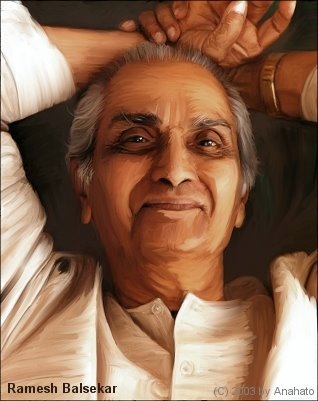
Balsekar the Sage
However much we think and believe that we're living our own lives, the fact of the matter is that our lives are being lived.
When you stop searching and let the impersonal consciousness take over, then it lets you in on the mystery of its own source, and you will know that things have no substance.
from
A Net of JewelsRamesh S. Balsekar
 Balsekar was an early (1930's) Physical Fitness and Body Sculpting adherent. Photos from this period were collected in a book published in 1940, some of which may be seen here . . .
 What is Awareness? Part 1:
The first thing we need to understand: what is "awareness" exactly?
Awareness is our ability to perceive either the activities of our minds, the input from our sensory organs or the nature of our awareness itself. And so based on these three, we can begin to comprehend the way in which our awareness functions in these varied experiences.
To simply observe our thoughts we experience two dominant elements: The "subject" and the "object" perceived. Awareness is the subject and of course our thoughts are the objects perceived. In this case, what is the nature of the subject, the awareness? What is it? The brain? The nervous system? No, the brain and nervous system are both just relay systems of information. Who is receiving this information?
There is "something" or "someone" at the center of all these perceptions as the "perceiver". What is this "perceiver"? Well, I'll tell you, it's "you"! Now what is "you"? We have thoughts of "me". But when we think of "me" or "I", we still have someone perceiving this concept or sensation of "me". As an example, if someone offends or criticizes you in embarrassing way, you may get this strong sense of "me" being attacked or harassed. At that moment, you could easily capture that strong sense of "me" if you noticed deliberately. "No one can talk to ME that way!" That sense of "me" is our ego. Our ego is the sum total of our thoughts about who we think we are in that moment. It's a self-definition that we hold in our minds. It's purely a product of thought, a cumulative progression of assumptions and decisions that began in our earliest years all the way up to today. It's not a fixed idea, as our opinion of who we think we are is always changing to some degree or another. So we have this psychological or mental image of who we think we are. That mental entity, our "me" thought, is not "awareness". And its not "who" we are. BUT, that mental entity or ego "thinks" that it is an actual and enduring self! But that is just another thought! Ok, so we can say our mind generates an idea of who and what it thinks it is. BUT, we are "awareness" not our mind. Our "awareness" can observe the mind... so it must be somehow separate from it. Get it? Our "awareness" is separate from our mind. Our "awareness" can experience all sorts of physical sensations, as the perceiver of those sensations. So it must not be the body either. It's not the physical body.
Ok, so let's summarize: Our "awareness" is not our thoughts, not our ego, not our "me" thought, not our brain, not our nervous system, not our mind, not our body... then what is it? Where is it? Who is it?
That's our first exercise: Ponder what we covered above and post your best guesses or if you know, then share that too!
End of Part 1: What is Awareness?
Jax
Jax
Friday, March 24, 2006
SURRENDER
The word "surrender" is used where there is a duality
between "me" and God. When this surrender happens,
this will which we think of as ours drops off, and there
is total acceptance that all that prevails is His Will.
A Net of Jewels
Ramesh S. Balsekar
between "me" and God. When this surrender happens,
this will which we think of as ours drops off, and there
is total acceptance that all that prevails is His Will.
A Net of Jewels
Ramesh S. Balsekar
The first sign of the realization of truth is tolerance. . .
Bowl of Saki, by Hazrat Inayat Khan
Commentary by Pir-o-Murshid Inayat Khan:
A Sufi tries to keep harmony in his surroundings,
the harmony which demands many sacrifices. It
makes one endure what one is not willing to endure,
it makes one overlook what one is not inclined to
overlook, it makes one tolerate what one is not
accustomed to tolerate, and it makes one forgive
and forget what one would never have forgotten if
it were not for the sake of harmony. But at whatever
cost harmony is attained, it is a good bargain. For
harmony is the secret of happiness, and in absence
of this a person living in palaces and rolling in gold
can be most unhappy.
A soul shows the proof of its evolution in the degree
of the tolerance it shows. The life in the lower creation
shows the lack of tolerance. The tendency of fighting
with one another, which one sees among beasts and
birds, shows the reason at the back of it, that
intolerance is born in their nature. ... But when a soul
has evolved still more, tolerance becomes the natural
thing for him. Because the highly evolved soul then
begins to realize 'Another person is not separate from
me, but the other person is myself. The separation is
on the surface of life, but in the depth of life I and the
other person are one.' Therefore tolerance is not learned
fully by trying to follow it as a good principle. It is learned
by having the love of God, by attaining the knowledge of
self, and by understanding the truth of life.
The first step to the attainment of the truth cannot be
taught in books, or be imparted by a teacher. It must
come spontaneously, namely through the love for truth.
The next step is to search for it; the third step is the
actual attainment. How can one attain? In order to attain
truth one must make one's own life truthful. ... Passing
from the state of natural man, through the state of being
a lover of truth and a seeker after truth, one begins to
express truth ... One begins to understand what the great
teachers have taught. Then one becomes tolerant to
the various religions. Nothing seems strange any more.
Nothing surprises. For now one begins to know the innermost
nature of man; one sees the cause behind every action.
Therefore tolerance and forgiveness and understanding of
others come naturally. The person who knows the truth is
the most tolerant. It is the knower of truth who is forgiving;
it is the knower of truth who understands another person's
point of view. It is the knower of truth who doesnot readily
voice his opinion, for he has respect for the opinions of
others.
When man gains insight into himself, he also gains insight
into the hearts of others. All this desire for learning occult
or mystical powers or psychic powers now disappears,
because he begins to see all this power in one truth -- loving
truth, seeking truth, looking for truth, living the truthful life.
That it is which opens all doors.
Commentary by Pir-o-Murshid Inayat Khan:
A Sufi tries to keep harmony in his surroundings,
the harmony which demands many sacrifices. It
makes one endure what one is not willing to endure,
it makes one overlook what one is not inclined to
overlook, it makes one tolerate what one is not
accustomed to tolerate, and it makes one forgive
and forget what one would never have forgotten if
it were not for the sake of harmony. But at whatever
cost harmony is attained, it is a good bargain. For
harmony is the secret of happiness, and in absence
of this a person living in palaces and rolling in gold
can be most unhappy.
A soul shows the proof of its evolution in the degree
of the tolerance it shows. The life in the lower creation
shows the lack of tolerance. The tendency of fighting
with one another, which one sees among beasts and
birds, shows the reason at the back of it, that
intolerance is born in their nature. ... But when a soul
has evolved still more, tolerance becomes the natural
thing for him. Because the highly evolved soul then
begins to realize 'Another person is not separate from
me, but the other person is myself. The separation is
on the surface of life, but in the depth of life I and the
other person are one.' Therefore tolerance is not learned
fully by trying to follow it as a good principle. It is learned
by having the love of God, by attaining the knowledge of
self, and by understanding the truth of life.
The first step to the attainment of the truth cannot be
taught in books, or be imparted by a teacher. It must
come spontaneously, namely through the love for truth.
The next step is to search for it; the third step is the
actual attainment. How can one attain? In order to attain
truth one must make one's own life truthful. ... Passing
from the state of natural man, through the state of being
a lover of truth and a seeker after truth, one begins to
express truth ... One begins to understand what the great
teachers have taught. Then one becomes tolerant to
the various religions. Nothing seems strange any more.
Nothing surprises. For now one begins to know the innermost
nature of man; one sees the cause behind every action.
Therefore tolerance and forgiveness and understanding of
others come naturally. The person who knows the truth is
the most tolerant. It is the knower of truth who is forgiving;
it is the knower of truth who understands another person's
point of view. It is the knower of truth who doesnot readily
voice his opinion, for he has respect for the opinions of
others.
When man gains insight into himself, he also gains insight
into the hearts of others. All this desire for learning occult
or mystical powers or psychic powers now disappears,
because he begins to see all this power in one truth -- loving
truth, seeking truth, looking for truth, living the truthful life.
That it is which opens all doors.
To Keep Quiet
Now we will count to twelve
And we’ll all keep still.
This one time upon the earth
let’s not speak in any language,
let’s stop for one second,
we won’t move our arms so much.
It would be a fragrant minute,
without hurry, without locomotives,
we would all be together
in one instantaneous restlessness.
The fishermen of the cold sea
wouldn’t harm the whales
and the worker of salt
would look at his broken hands.
Those who prepare green wars,
wars of gas, wars of fire,
victory without survivors,
will put on clean clothes
and walk alongside their brothers
in the shade, without doing anything.
Don’t confuse what I want
with definitive inaction:
life is the only thing that matters,
I don’t want anything to do with death.
If we weren’t unanimous
moving our lives so much,
perhaps we could do nothing for once,
perhaps a great silence can
interrupt this sadness,
this never understanding ourselves,
and threatening ourselves with death,
perhaps the earth will teach us
when everything seems dead
and then everything was alive.
Now I will count till 12
and you be quiet and I will go.
~Pablo Neruda
Thursday, March 23, 2006
Belief
Belief
"What fills everything, above, below and around, itself Being - Consciousness - Bliss, non-dual, infinite, eternal, one only, know that to be Brahman (GOD)"
Ramana, Shankara and the Forty Verses
The mind is only the substance of our own creation. From birth we mould our thoughts according to firstly, the way our parents respond to life, and then secondly, to how outside influences affect us. We build up our belief system by what we fear and by what we desire. For instance, if our parents teach us that fire is bad, then, until we understand the nature of fire we will believe that we should be frightened of it. One upon the next, we layer our beliefs like playing cards. Our fears are triggered when we experience an event that is related to one of our beliefs. Our mind pulls out the relevant card and says to you, "ah, the last time we heard about fire, we felt that we should be afraid. So, let us now experience fear." The body responds and we feel fear. This in itself would not be a problem. However, we as individuals are afraid of the feeling of fear - one of life's little ironies! - and so we push it as far away as we can. This is like cutting our skin, letting a scar form and then cutting it again (for want of a better example!!) The fear, like scar tissue becomes harder and more firmly rooted within our psyche. The only way to remove this scar is to identify the source of the belief and understand it. We find the first time when we had the experience and try to "know" how we felt at the time. Then, by accepting the fear, we resolve the issue. So in other words, instead of pushing the fear away, we embrace it. When we learn about the nature of our beliefs then we are not governed by them but rather we become the governors.
Through constant appraisal of our mind - the beliefs (and the fears and desires that feed them) - we are able to acknowledge that none of our emotional experiences are solid i.e. they are each flexible and thus can be dissolved through our own will. When we choose to do this, our minds become more and more in our control.
The Yogi understands that if he observes each of his fears and desires in this way, he will slowly remove them from the deck of cards. With each one removed a steadiness of mind is increased, so that in time, there is nothing left to take away. It is like having a very dirty window which is your mind. On one side is your conscious self (a mirror) and on the other is the Diamond that is your Higher Self. The object of "enlightenment" is to clean up the window of your mind, so that in effect your Higher Self can look upon the mirror and see Itself, and thus have understanding of it's true nature.Nicholas Morris
SILENT POND
George Bush on Global Warmings !
Or, Will Ferrell doing George Bush doing Global Warmings.
Have a good Laf ! ! ! Here . . .
Have a good Laf ! ! ! Here . . .
FEAR

Trust the gods within.
Accept given boons.
Illusion is reality’s border:
Pierce fear to go beyond.
In your meditations, you will meet gods. These gods are nothing more than the holiest aspects of your own mind: They are not other beings. Your inner gods will grant gifts of knowledge and power. Accept what comes your way without doubt and without fear. You can trust your gods. They will never betray you, for you cannot betray yourself.
Such trust dissolves fear and regret. You will find resolution to your inner conflicts. The gods will direct you forward to the very order of reality itself. On the other side is vast profundity, the ultimate nature of existence. But the border can be crossed only if you have resolved all fear and regret.
All fear comes from our sense of self. When we stand at the border of reality, we are afraid that we will lose our identities by plunging in. We are afraid of being destroyed. But we came from Tao in the first place. We are Tao. To return to Tao is not to be negated, but to become one with the entire universe. True, we will no longer be who we are now, but we will be one with Tao. In that state, there is no need for fear.
by Deng Ming-Dao
from the book 365 Tao Daily Meditations
ISBN 0-06--250223-9
to subscribe to the daily Taoist meditations,
please send an email to
"mailto:duckdaotsu@earthlink.net"
and write SUBSCRIBE TAO in the subject line.
Thanks to Lisbeth West
Wednesday, March 22, 2006
METTA
"A kind heart is one of the principal things we are
trying to develop. If we run around childishly telling
others, 'I'm this religion, and you're that religion. But,
mine is better,' it is like turning chocolate frosting
into garbage: what was delicious becomes useless.
Instead, we would be much wiser to look inside
ourselves and apply the antidotes to intolerance, pride,
and attachment. The true criterion of whether we area
religious or spiritual person is whether we have a kind
heart toward others and a wise approach to life.
These qualities are internal and cannot be seen with our
eyes. They are gained by honestly looking at our own
thoughts, words and actions, discriminating which ones
to encourage and which ones to abandon, and then
engaging in the practices to develop compassion
and wisdom in order to transform ourselves."
~Venerable Thubten Chodron
trying to develop. If we run around childishly telling
others, 'I'm this religion, and you're that religion. But,
mine is better,' it is like turning chocolate frosting
into garbage: what was delicious becomes useless.
Instead, we would be much wiser to look inside
ourselves and apply the antidotes to intolerance, pride,
and attachment. The true criterion of whether we area
religious or spiritual person is whether we have a kind
heart toward others and a wise approach to life.
These qualities are internal and cannot be seen with our
eyes. They are gained by honestly looking at our own
thoughts, words and actions, discriminating which ones
to encourage and which ones to abandon, and then
engaging in the practices to develop compassion
and wisdom in order to transform ourselves."
~Venerable Thubten Chodron
Edward Wilson and Hardwired Religion
Sociobiology founder Edward O. Wilson explains why we're hard-wired to form tribalistic religions, denies that "evolutionism" is a faith, and says that heaven, if it existed, would be hell.
Mar. 21, 2006 | For a man who's obsessed with tiny critters, Edward O. Wilson has a strange knack for stirring up controversy about life's biggest questions. The Harvard biologist is a renowned expert on insects, co-author of the Pulitzer Prize-winning book "The Ants." But it was his seminal 1975 book "Sociobiology," which laid the groundwork for the new field of evolutionary psychology, that made Wilson a scientific luminary -- and a major intellectual force in America. That book, along with its Pulitzer Prize-winning sequel, "On Human Nature," argued that many human behaviors -- including aggression, altruism and hypocrisy -- are shaped by evolution. Wilson's tilt toward nature in the age-old nature/nurture debate may have put him on the map, but it also made plenty of enemies. Fellow Harvard biologists Stephen Jay Gould and Richard Lewontin denounced sociobiology, saying it provided a genetic justification for racism and Nazi ideology. Wilson's classes were picketed. In one famous incident, demonstrators at a scientific meeting stormed the stage where he was speaking and dumped a pitcher of water over his head, chanting, "Wilson, you're all wet!"
Over the years, sociobiology -- once so controversial -- became a widely accepted branch of science. Ultimately, Wilson won the National Medal of Science for his scholarship. And his own popularity soared when he emerged as a champion of biodiversity and a passionate advocate for endangered species. His 1992 book "The Diversity of Life" became a bestseller. But he stirred up more trouble in the late '90s with another book, "Consilience." This was his attempt to outline a unified theory of knowledge, which had the effect of elevating science at the expense of religion and the arts. In his view, knowledge of the world ultimately comes down to chemistry, biology and -- above all -- physics; people are just extremely complicated machines. Wendell Berry, among other critics, railed against Wilson's scientific reductionism, calling it a "modern superstition."
Wilson is now retired, though -- at 76 -- he still spends plenty of time at his Harvard lab. And he continues to write and lecture. He recently edited a collection of Charles Darwin's books titled "From So Simple a Beginning" (W.W. Norton). In person, Wilson is a courtly Southerner. He's an affable man who laughs easily and -- unlike many scientists -- is quite willing to speculate on the most cosmic questions. This was evident when he stopped by my radio studio before giving a sold-out lecture at the University of Wisconsin. We talked about Darwin and the growing rift between science and religion, as well as Wilson's own take on religion -- his "provisional deism" and his personal horror of an eternal afterlife in heaven.
What were the personal and intellectual qualities that made Darwin such a great scientist?
A relentlessly inquiring mind, a love of natural history acquired as a child, the extraordinary opportunity presented by the voyage of the Beagle to travel around the world at exactly the right age when the mind is opening, the opportunity in the scientific world to make a major discovery, and -- I should not overlook -- being a country squire with no economic pressures.
Did he have any particular agenda when he set out on his voyage on the Beagle?
I don't think so. He was a deeply religious man. He hadn't thought about evolution at all. What he was was an all-purpose observer, with a particular interest in natural history, and of course in beetles, which were the love of his life.
And it's worth pointing out that when Darwin first set out on the Beagle, he brought his own Bible. He had to overturn his whole upbringing to come up with this revolutionary idea.
Darwin departed England a devout Bible literalist. After failing his effort to become a doctor, he had in fact trained as a minister at Cambridge University. As he says in his autobiography, he would even pull out the Bible to settle some argument with other members of the ship's crew. But then as the trip went on, for reasons Darwin really never disclosed but I don't think had to do with the idea of evolution, he gradually dropped his Christian beliefs. Becoming a man of the world and much more aware of other cultures and religious beliefs, he realized that the stories of the Bible were basically no different than the stories of these other religions.
But what really turned him against religion was the doctrine of damnation. He said if the Bible is true, you must be redeemed in Christ and be a believer in order to go to heaven. And others will be condemned. And that includes my brothers and all my best friends. And he said that is a damnable doctrine. Those are his words.
Darwin's own transformation from devout Christian to non-believer obviously raises significant questions in our own time. It raises a very provocative question: If you fully accept the theory of evolution by natural selection, does that logically lead you to atheism?
Well, it does up to the origin of the mind and spirit. And one of the Vatican's scientific spokesmen, incidentally, just recently turned thumbs down on intelligent design. John Paul II took the position that evolution's been pretty well proved, and certainly was acceptable as God's way of creating the diversity of life. But the human soul was injected by God. So that's a kind of compromise position that a lot of devoutly religious people have taken.
By Steve Paulson
Tuesday, March 21, 2006
INTEGRAL SEXOLOGY
"I believe integral theory logically demands the creation of a sex positive society
and the rejection and elimination of all sex negative ideologies and attitudes."
Ray Harris
and the rejection and elimination of all sex negative ideologies and attitudes."
Ray Harris
We're all interested in sex. After all, it's the third appetite � drink, food and sex, and despite this powerful taboos exist around sex. It's not a simple matter. Some people experience discomfort when talking about it or doing it. It is also clearly connected to spirituality - yet some religions have an anti-sex morality�
So what might integral theory suggest about sex?
At the end of the 19th century a number of writers had begun to question the prevailing Western attitudes toward sex. One pioneering writer was Havelock Ellis. He wrote a book suggesting that homosexuality was simple a natural variation. He also pioneered the idea that women can and ought to enjoy sex. Space does not allow me to go into detail but it is well known that there were some very peculiar ideas about sex: orgasm in women was regarded as a sign of hysteria, masturbation was regarded as morally and physically weakening and homosexuality was seen as aberrant. All of this was challenged by a group of thinkers who argued that the study of sexuality should be pursued scientifically, independent of moral prejudice. This field became known as sexology.
At the same time anthropology began to be developed as a discipline. The colonialist expansion introduced Europeans to a wide variety of cultural practices, including radically different views toward sex. Havelock Ellis[1] wrote the forword to a ground breaking book by Stanislav Malinowski[2] called 'The Sexual Life of Savages in North-Western Melanesia'. This book explored the sexual practices of the Trobriand Islanders and it revealed the dynamics of a very liberal and open approach. Malinowski challenged Freud's theory of the Oedipus complex and sexual libertarians found evidence in his work that much of the European attitude was based on a false and irrational moral fear.
These new approaches led to the creation of The World League for Sexual Reform,[3] which included Ellis, Freud, Wilhelm Reich and the writers Aldous Huxley and DH Lawrence. This group was founded by Magnus Hirschfeld[4] who also started the first institute devoted to the discipline of sexology, the Institute for Sexual Research in Berlin.
The rise of the Nazis and the Second World War interrupted research into sexology (The Nazis destroyed the ISR in 1933 � many of the images of Nazis burning books are of them destroying the ISR library). The work of sexology lay dormant until Alfred Kinsey[5] and afterwards, Masters and Johnson[6]. The field of sexology is now fairly well established.
How can integral theory add to this discipline? Is there an integral sexology?
DREAM MACHINES
The human imagination is an amazing thing. As children, we spend much of our time in imaginary worlds, substituting toys and make-believe for the real surroundings that we are just beginning to explore and understand. As we play, we learn. And as we grow, our play gets more complicated. We add rules and goals. The result is something we call games.
Now an entire generation has grown up with a different set of games than any before it - and it plays these games in different ways. Just watch a kid with a new videogame. The last thing they do is read the manual. Instead, they pick up the controller and start mashing buttons to see what happens. This isn't a random process; it's the essence of the scientific method. Through trial and error, players build a model of the underlying game based on empirical evidence collected through play. As the players refine this model, they begin to master the game world. It's a rapid cycle of hypothesis, experiment, and analysis. And it's a fundamentally different take on problem-solving than the linear, read-the-manual-first approach of their parents.
In an era of structured education and standardized testing, this generational difference might not yet be evident. But the gamers' mindset - the fact that they are learning in a totally new way - means they'll treat the world as a place for creation, not consumption. This is the true impact videogames will have on our culture.
Society, however, notices only the negative. Most people on the far side of the generational divide - elders - look at games and see a list of ills (they're violent, addictive, childish, worthless). Some of these labels may be deserved. But the positive aspects of gaming - creativity, community, self-esteem, problem-solving - are somehow less visible to nongamers.
I think part of this stems from the fact that watching someone play a game is a different experience than actually holding the controller and playing it yourself. Vastly different. Imagine that all you knew about movies was gleaned through observing the audience in a theater - but that you had never watched a film. You would conclude that movies induce lethargy and junk-food binges. That may be true, but you're missing the big picture.
So it's time to reconsider games, to recognize what's different about them and how they benefit - not denigrate - culture. Consider, for instance, their "possibility space": Games usually start at a well-defined state (the setup in chess, for instance) and end when a specific state is reached (the king is checkmated). Players navigate this possibility space by their choices and actions; every player's path is unique.
By Will Wright
Continue reading . . .
Monday, March 20, 2006
The Return

We all came into this world gifted with innocence, but gradually, as we became more intelligent, we lost our innocence.
We were born with silence and as we grew up, we lost the silence and were filled with words.
We lived in our hearts and as time passed, we moved into our heads.
Now the reversal of this journey is enlightenment.
It is the journey from the head back to the heart, from words back to
silence; getting back to our innocence in spite of our intelligence.
Although very simple, this is a great achievement.
Eckhart Tolle
Remaining Whole in the Face of the Truth
Spiritual development is moral development. It's the movement from division to wholeness. Most of us are deeply divided, which means we have mixed motives. This is why most of us are untrustworthy. Under pressure, the self divides and suddenly you don't know who a person is; you don't know what they are going to do. So when we become interested in evolving, we have to begin to face this deep division within ourselves. We have to confront the darkest motives that exist within us, the deeply unwholesome drives of the ego, and we have to emotionally get in touch with the effect we have on those around us when we act from those motives.
As we evolve, we become a lot more sensitive to the deeply destructive nature of ego, in ourselves and in others. That's the awakening of conscience—a higher conscience that has nothing to do with ego but comes from the level of the soul. But it takes humility to develop at this level. Most of us cherish a self-image that has very little to do with how we really are. When the true picture is revealed, some people come to their knees in humility. Others fall into a narcissistic rage, unable to bear the truth. It's at moments like these, when there is tremendous evolutionary pressure, that the self divides.
If you make a decision to remain whole under pressure, to face the truth without wavering, what emerges is literally a new human being. You discover self-confidence, spiritual and moral strength, self-respect and dignity. That's soul development. But it takes a tremendous commitment and a deep surrender to resist the temptation to divide. If the self doesn't divide under pressure, then evolution takes place in real time.
 | Andrew Cohen |
Back to the Garden
We all came into this world gifted with innocence,
but gradually, as we became more intelligent, we
lost our innocence.
We were born with silence and as we grew up,
we lost the silence and were filled with words.
We lived in our hearts and as time passed, we
moved into our heads.
Now the reversal of this journey is enlightenment.
It is the journey from the head back to the heart,
from words back to silence; getting back to our
innocence in spite of our intelligence.
Although very simple, this is a great achievement.
Eckhart Tolle
but gradually, as we became more intelligent, we
lost our innocence.
We were born with silence and as we grew up,
we lost the silence and were filled with words.
We lived in our hearts and as time passed, we
moved into our heads.
Now the reversal of this journey is enlightenment.
It is the journey from the head back to the heart,
from words back to silence; getting back to our
innocence in spite of our intelligence.
Although very simple, this is a great achievement.
Eckhart Tolle
Sunday, March 19, 2006
Ramana Maharshi
 There is neither creation nor destruction,
neither destiny nor free will,
neither path nor achievement.
This is the final truth.
Sincerity is spiritual humility.
No man can say,
"I am humble," for any expression "I am"
precludes humility. Humility says,
"Thou art, "and does not qualify or posit anything.
It loses itself by itself.
Iniyat Hazrat Khan
Hat tip Peter Kloppert
"I am humble," for any expression "I am"
precludes humility. Humility says,
"Thou art, "and does not qualify or posit anything.
It loses itself by itself.
Iniyat Hazrat Khan
Hat tip Peter Kloppert
How to remember to be aware of Awareness
I find it impossible to remember to be
aware,or to be aware I am aware.
So what do you do to remember to
be present?
Is it just something you do and then
do more of?
How does a person grow in
Mindfulness?
Thanks, Paul
Hi Paul!
Your difficulty in being able to remember to be aware, is an issue of clarity and mindfulness. I would normally say for such a symptom as you described, that you still need to work on the first step of reducing the distractions of your mind's activities which seem to distract you from being aware of your awareness. You do this by "mind training". This is not Dzogchen practice. It's a necessary step leading there. You need to "catch" yourself every time you start to drift off in thought by bringing yourself to "present here and now" awareness. You can begin by doing some sitting meditation. Just sit there and observe the room as it is. No plan or intention except the commitment to "focus" on the physical and sensory experience of the environment in lieu of chasing the thoughts that pass through your mind. Just perceive the room, your body, your breath. Next start counting your breaths from 1 to 10 and start over again and again. Just focus on your breathing... when thoughts arise don't feed them or pursue them, just drop them like a "hot potato". Keep returning to just being aware of your breathing, the perceptions of the room as it is, without thinking or judging. Just notice everything. If you catch yourself drifting off in thought, just pull yourself back to just being "mindful " of the moment and let the thought go.