Followers

Saturday, September 02, 2006

one's not half two

one’s not half two. It’s two are halves of one:

which halves reintegrating, shall occur

no death and any quantity; but than

all numerable mosts the actual more

minds ignorant of stern miraculous this every truth

beware of heartless them

(given the scalpel, they dissect a kiss;

or, sold the reason, they undream a dream)

one is the song which fiends and angels sing;

all murdering lies by mortals told make two.

Let liars wilt, repaying life they’re loaned;

We (by a gift called dying born) must grow

deep in dark least ourselves remembering

love only rides his year.

All lose, whole find

e. e. cummings

Wednesday, August 30, 2006

No personal, individual effort can possibly
lead to enlightenment. On
the contrary, what
is necessary is to rest helpless in beingness,

knowing that we are nothing - to be in the
nothingness of the no-mind
state in which
all conceptualizing has subsided into passive

witnessing. In this state whatever happens
will be not our doing but
the pure universal
functioning to which we have relinquished
all control.

~
Ramesh S. Balsekar

Wednesday, August 16, 2006

The Place Where We Are Right


From the place where we are right
flowers will never grow
in the spring.
The place where we are right
is hard and trampled
like a yard.
But doubts and loves
dig up the world
like a mole, a plow.
And a whisper will be heard in the place
where the ruined
house once stood.

~ Yehuda Amichai

Sunday, August 13, 2006

The lover of nature is the true worshipper of God.


Bowl of Saki, by Hazrat Inayat Khan

Commentary by Pir-o-Murshid Inayat Khan:

A true worshipper of God sees His presence in all
forms, and thus in
respecting others he respects God.
It may even develop to such an
extent that the true
worshipper of God, the Omnipresent, walks gently

on the earth, bowing in his heart even to every tree
and plant, and
it is then that the worshipper forms
a communion with the Divine
Beloved at all times,
when he is awake and when he is asleep.


Anyone who has some knowledge of mysticism and
of the lives of the
mystics knows that what always
attracts the mystic most is nature.
Nature is his bread
and wine. Nature is his soul's nourishment.

Nature inspires him, uplifts him and gives him the
solitude for which
his soul continually longs. Every
soul born with a mystical tendency
is constantly
drawn towards nature; in nature that soul finds its

life's demand, as it is said in the Vadan, 'Art is dear
to my heart,
but nature is near to my soul'. ... Nature
does not teach the glory
of God; it need not teach
this as nature itself is the glory of God.
People wish
to study astrology and other subjects in order to

understand better, but if we study astrology then we
are sure to
arrive at an interpretation which is given
by a man, whereas what we
should read from nature
is what nature gives us and not what any book
teaches
us.


There comes a time with the maturity of the soul when
every thing and
every being begins to reveal its nature
to us. We do not need to read
their lives. We do not
need to read their theories. We know then that
this wide
nature in its four aspects is ever-revealing and that one

can always communicate with it, but that in spite of this
it is not
the privilege of every soul to read it. Many souls
remain blind with
open eyes. They are in heaven, but not
allowed to look at heaven;
they are in paradise, but not
allowed to enjoy the beauties of
paradise. It is just like
a person sleeping on a pile of gems and
jewels. From the
moment man's eyes open and he begins to read the

book of nature he begins to live; and he continues to live
forever.


'There is One Holy Book, the sacred manuscript of nature,
the only
scripture which can enlighten the reader.' Most
people consider as
sacred scriptures only certain books
or scrolls written by the hand
of man, and carefully
preserved as holy, to be handed down to
posterity as
divinerevelation. Men have fought and disputed over the

authenticity of these books, have refused to accept any
other book of
similar character, and, clinging thus to the
book and losing the
sense of it have formed diverse sects.
The Sufi has in all ages
respected all such books, and has
traced in the Vedanta, Zend-Avesta,
Kabbala, Bible, Quran,
and all other sacred scriptures, the same
truth which he
reads in the incorruptible manuscript of nature, the
only
Holy Book, the perfect and living model that teaches the
inner
law of life: all scriptures before nature's manuscript
are as little
pools of water before the ocean.

To the eye of the seer every leaf of the tree is a page of
the holy
book that contains divine revelation, and he is
inspired every moment
of his life by constantly reading
and understanding the holy script
of nature

Saturday, August 12, 2006

so what else are my senses not picking up?


As you sleep your 8 hrs. a night, you, your bed, and the Earth go 536,000 miles around the sun. During that same time you, and the solar system traveled, 166 million miles around the galaxy. That is fast! 1/1000 of the speed of light. At a slighter more leisurely pace, you, and the galaxy drifted toward Andromeda at 80 miles per second, or roughly five millions miles in eight hours. All these, as space itself expands at 14 miles per second. Who says you're not going places! And yet, you don't feel a thing, only the serenity of an immobility which isn't there.

Pete S.

Thursday, August 10, 2006

Narrowness is primitiveness; it is the breadth of heart that proves

One person will do something and consider that there is great
wisdom
in his sacrifice, while another who is not evolved
enough to
understand it will say, 'How very foolish!' Remember
therefore that
not only to the wise person the man of little
sense seems foolish,
but even to the foolish person the wise
one seems foolish. The points
of view of both are different:
one looks from the top of the tower,
the other standing on
the ground. So there is a vast difference in
the range of their
sight.


It is a man's outlook on life which makes him broad or narrow,
and it
is the grade of his evolution which gives man the
illumination of
sacrifice. What a man was not inclined to do
last year, he may be
inclined to do this year; the sacrifice
one could not make yesterday,
one can make today, for the
rate of speed of man's evolution cannot
be limited to a
particular standard. A broad outlook enriches man and
a high
point of view ennobles the soul.


Once you have linked yourself with love, a flood of inspiration
is
revealed to you, whatever the subject, whatever the problem
in life
may be. Whatever it be that your eye casts its glance
upon, it will
disclose itself. Then you are on the real road, and
what a joy this
is!

Breadth of heart is what is needed for all this. ... It is the
breadth of heart that makes a man great, whereas it is
narrowness of
heart that makes him small. The great heart
does not think about how
troublesome a person is, and why
he should be bothered like this. It
is only the narrow of
heart that thinks, 'I will cause him some
trouble.' It may
be justified, but still it is a narrow thought. The
one with
a broad heart thinks,' This is a small thing, I can put up

with it; not much harm will come from it.'

The Nizam wrote this verse, 'The width of the land and the
water
cannot be compared with the width of man's heart.
If man's heart is
wide enough there is nothing greater than
that.' The heart becomes
wide by forgetting the self, and
narrow by thinking of the self and
by pitying one's self.
To gain a wide and broad heart you must have
something
before you to look upon and to rest your intelligence upon,

and that something is the God ideal. This is the prescription
for
killing the self, and to kill the self is the basis of every
religion.

Bowl of Saki, by Hazrat Inayat Khan

Commentary by Pir-o-Murshid Inayat Khan
Joel Guzman Accordion Jam

There is something so light about this man and his accordion.
72 Virgins

Wednesday, August 09, 2006

As long as there is a 'you'

doing or not-doing, thinking or
not-thinking, meditating
or not-meditating you are
no closer to home than the
day you were born.
"The Tenth Man" by Wei Wu Wei

One night while the Buddha was
meditating, a brilliant
and beautiful
devata named Rohitassa appeared
in front of him.
He told the Buddha,
"When I was a human being, I was
a spiritual
seeker of great psychic
power, a sky walker. Even though I
journeyed
for 100 years to reach
the end of the world, with great
determination
amd resolution, I could
not come to the end ofthe world. I died
on the joruney
before I found it. So can you tell me, is it
possible to journey
to the end of the world?"
And the Buddha replied, "It is not
possible to reach the end
of the world by walking, but I tell
you unless you reach the
end of the world,you will not reach
the end of suffering. "
Rohitassa was puzzled and said, "Please explain
this to me,
Venerable Sir." The Buddha replied, "In this very fathom-long
body is the world, the origin of the world, the cessation
of the world, and the way leading to the cessation of the world."
(A 4.45, S 2.26)

In this instance, the Buddha used the exact formulation as
in the
Four Noble Truths. The world, "loka", in this respect means the
world of our experience. And this is how the Buddha almost always

uses the term "the world". He's referring to the world as we experience
it.
This includes


Sight

Sound

Smell
Taste

Touch
Thought

Emotion
Feeling

That's it. That's what "the world" is - my world, your
world.
It's not the abstracted, geographical planet,
universe-type world,
it's the direct experience of the
planet, the people, the cosmos. Here
is the origin
of the world, the cessation of the world, and the
way
leading to the cessation of the world. He said that
as long as we created "me and my experience" -
"me in
here" and "the world out there" - then there is dukkha,

we're stuck in the world of subject and object. Geographically,

it's impossible to journey to the end of the world. It's only
when we
come to the cessation of the world, which literally
means the cessation
of its otherness, its thingness, will
we reach the end of dukkha,
unsatisfactoriness. When we
stop creating sense objects as absolute
realities and stop
seeing thoughts and feelings as solid things, there
is
cessation.
To see that the world is within our minds is one
way of working
with these principles. The whole universe
is embraced when we
realized that it's happening within
our minds. And that moment
when we recognize that it all
happens HERE, it ceases. Its thingness
ceases. Its
substantiality ceases. Its insubstantiality is known.
We're not
imputing soidity to it, a reality it doesn't possess. We're
just
looking directly at the world, knowing it fully and completely.

It all happens internally. When we stop creating the world
we stop
creating each other. We stop imputing the sense of
solidity that creates
a sense of separation. Yet we do not
cut off our senses in any way.
Actually,we shed the veneer,
the films of confusion, of opinion,
of judgment and conditioning
so that we can see the way things
really are. At that moment
dukkha ceases.

There is knowing.
There
is liberation.
There is freedom.
There is no dukkha.


-Amaro Bhikkhu

Tuesday, August 08, 2006

Evil wins when it scares us into killing evildoers.
In doing that, we think we're fighting evil, when in
reality, we're only dancing by its drum.

Evil can only be defeated by denying it the publicity,
the notoriety it seeks. The battle is over people's
minds, and must be won with ideas, not bullets.
Killing evildoers is transforming them into martyrs
and heroes. That always adds glamour to their
cause.

Evildoers are always a miniscule minority. The
number of victims they cause is always insignificant,
when compared to such accepted killers as car accidents.

Fear magnifies the danger they represent. We seldom
see any national campaign in favor of reducing car
accidents, or preventable deaths caused by lack
of hygiene in our hospitals. Yearly, those numbers are
consistently higher than deaths caused by evildoers
of all sorts.

Fight evil with ideas, not bullets. Evil becomes
contagious when blood is spilled in the name of Good.

Pete S.

Saturday, July 29, 2006

Mindful

Every day
I see or hear
something
that more or less

kills me
with delight,
that leaves me
like a needle

in the haystack
of light.
It was what I was born for -
to look, to listen,

to lose myself
inside this soft world -
to instruct myself
over and over

in joy,
and acclamation.
Nor am I talking
about the exceptional,

the fearful, the dreadful,
the very extravagant -
but of the ordinary,
the common, the very drab,

the daily presentations.
Oh, good scholar,
I say to myself,
how can you help

but grow wise
with such teachings
as these -
the untrimmable light

of the world,
the ocean's shine,
the prayers that are made
out of grass?


Mary Oliver

Friday, July 28, 2006

The Summer Day


Who made the world?
Who made the swan, and the black bear?
Who made the grasshopper?
This grasshopper, I mean--
the one who has flung herself out of the grass,
the one who is eating sugar out of my hand,
who is moving her jaws back and forth instead of up and down,
who is gazing around with her enormous and complicated eyes.
Now she lifts her pale forearms and thoroughly washes her face.
Now she snaps her wings open, and floats away.

I don't know exactly what a prayer is.
I do know how to pay attention, how to fall down
into the grass, how to kneel down in the grass,
how to be idle and blessed, how to stroll through the fields,
which is what I have been doing all day.
Tell me, what else should I have done?
Doesn't everything die at last, and too soon?
Tell me, what is it you plan to do
with your one wild and precious life?


~ Mary Oliver

Thursday, July 27, 2006

Balsekar on Surrender . . .


It is a curious fact that one's chances
of survival are best when there is no
anxiety to survive. There is a special
effectiveness or power of virtuality
that is available to those who do not
exhaust and dissipate themselves with
anxiety. The subtlety, however, is that
anxiety also includes any positive effort
to eliminate anxiety--and this is precisely
where true understanding comes into
its own by accepting wholeheartedly
whatever life brings without resistance or
recoil.

One day ...


... I will
say
the gift I once had has been taken.
The place I have made for myself
belongs to another.
The words I have sung
are being sung by the ones
I would want.
Then I will be ready
for that voice
and the still silence in which it arrives.
And if my faith is good
then we'll meet again
on the road
and we'll be thirsty,
and stop
and laugh
and drink together again
from the deep well of things as they are.
~ David Whyte ~
deep thanks to Joe Riley

to Panhala

Wednesday, July 26, 2006

Year after year

I dug in the earth
looking for the blue of heaven
only to feel
the pile of dirt
choking me
until once in the dead of night
I tripped on a broken brick
and kicked it into the air
and saw that without a thought
I had smashed the bones
of the empty sky


~Muso Soseki

Tuesday, July 25, 2006

I am all hollowed out now

Like a reed.
I gave everything for this.
And still I laughingly wonder:
How could it have been so cheap?


Adyashanti

Friday, July 21, 2006

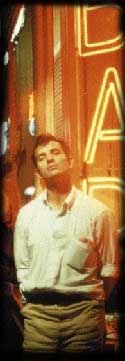
The Beat Speak


The taste
of rain
-- Why kneel?

Jack Kerouac

Thursday, July 20, 2006

Done Dead !!

Saturday, July 15, 2006

HE WHO KNOWS THIS KNOWS

You are wise.
You play and work and meditate.

But still your mind desires
That which is beyond everything,
Where all desires vanish.

Striving is the root of sorrow.

But who understands this?

Only when you are blessed
With the understanding of this teaching
Will you find freedom.


-Ashtavakra Gita 16:2-3

Tuesday, July 11, 2006

There is someone I know . . .

who is gonna enjoy this . . .

THIS . . .

Monday, July 10, 2006

Fourteen billion years ago,

something came from nothing. The energy and intelligence
that initiated that explosion is the same energy that is driving
this whole process right now. It is what I call the evolutionary
impulse or creative principle. And at the leading edge of
development, that same evolutionary impulse emerges
in human awareness as the spiritual impulse, the urge to
become more conscious. It is experienced as the
mysterious longing to develop spiritually, the ecstatic
compulsion to become more awake and more aware.
That impulse is what I call the authentic self. And
anybody who experiences this authentic self will
realize, upon reflection, that it is a completely
different part of the self than the ego. The ego
and the authentic self are parallel lines that never meet.

The ego is full of unresolved issues and unfulfilled desires,
deeply fearful and ambivalent about the very fact of being
alive. But the authentic self is only interested in creating
the future. And that part of your self and that part of my
self is not self-conscious and is not afraid of life. In the
authentic self, there's not a trace of ambivalence. There's
no hesitation. There's no doubt. There's no existential
confusion. And it's not a choice that needs to be made.
The authentic self, in you and in me, once we awaken
to it, is already completely committed. Absolute conviction
is inherent in the nature of the authentic self, and that is
why when any one of us awakens to that self, we experience
an intoxicating joy and confidence, a fearless passion and
pure doubtless conviction about being here and doing things
right in order to create a better future. Why? Because we
recognize that that is the very reason we are here.

Andrew Cohen

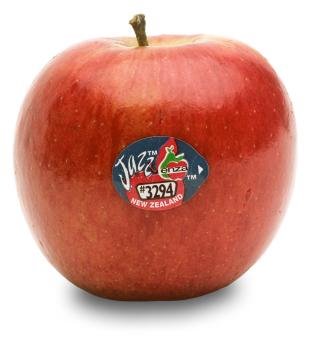
A New Best Apple


In, of all places, Albertson's looking for apples, not the
season for domestic apples, and in the low supply
found a name I was unfamaliar with, Jazz. Picked up
a few, and sometime later at first bite, to my supprise,
I was eating a very very wonderful apple. Crisp, not as
sweet as last Fall's pick, The Honey Crisp, but with more
complexity.
Sticker says the apple is from ENZA, a New Zealand company
that brought the Fuji to us a few years ago, also the Pink
Lady, and the Braeburn's along with others. Matter of fact,
Jazz is a cross between Royal Fala and Braeburn, and get
this, Jazz even has it's own cool web site.

"You have a purpose

only as long as you are not complete;
until then completeness, perfection, is
the purpose. But when you are complete
in yourself, fully integrated within and
without, then you enjoy the universe;
you do not labor at it."
~Sri Nisargadatta Maharaj

Saturday, July 08, 2006

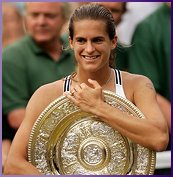
Amelie Mauresmo


CHAMPION
WIMBLEDON LADIES SINGLES
2006

Friday, July 07, 2006

The state of the fasting mind or NO-MIND is by
no means a condition of idiotic vacuity but precisely
the opposite; a state of perfect, natural virtuosity,
intelligence and spontaneous power.

~ Ramesh S. Balsekar

Thursday, July 06, 2006

We look but don't see it

and call it indistinct
we listen but don't hear it
and call it faint
we reach but don't grasp it
and call it ethereal
three failed means to knowledge
we weave into one
with no light above
with no shade below
too fine to be named
returning to nothing
this is the formless form
the immaterial image
this is the waxing waning
we meet without seeing its face
we follow without seeing its back
holding onto this very Way
we rule this very realm
and discover its ancient past
this is the thread of the Way.

TaoteChing #14
translated by Red Pine

Our journey had advanced --

Our feet were almost come
To that odd Fork in Being's Road --
Eternity -- by Term --

Our pace took sudden awe --
Our feet -- reluctant -- led --
Before -- were Cities -- but Between --
The Forest of the Dead --

Retreat -- was out of Hope --
Behind -- a Sealed Route --
Eternity's White Flag -- Before --
And God -- at every Gate --
~ Emily Dickinson

Wednesday, July 05, 2006

Tuesday, July 04, 2006

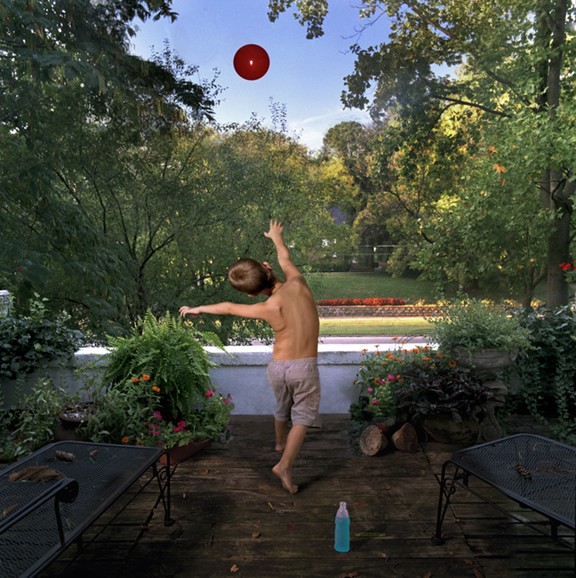
Julie Blackmon

I'm so taken with this artist.
Hard to choose among many images, but this one I blew up to screen size (17")
and it's just breathtaking.

PLEASE GO HERE . . .